
The rise in petro-product prices have been necessitated by rising global costs of petroleum and the fact that the price of petrol and diesel has not been increased in India since January 2004.
A higher government borrowing will 'crowd-out' the private borrowing and push interest rates higher.
The government is exploring various options, including a marginal hike in prices of petrol and diesel, and a possible duty cut to ease burden on state-run oil firms that are increasingly losing revenue due to global crude prices surging close to $100 a barrel. "We will do all that is possible to protect the interests of our PSUs," Petroleum Minister Murli Deora said after a brief meeting with Prime Minister Manmohan Singh on the issue on Friday.

The Israel-Iran conflict has entered a 'decisive phase' after the United States bombed three major Iranian nuclear sites Sunday morning, feel strategic affairs experts with some of them arguing it was Washington, DC's 'responsibility' to not get involved in the military standoff.

Perhaps for the first time, petrol in India costs more than the superior jet fuel (ATF) used in aeroplanes, as the government has levied a record excise duty on the fuel used in two-wheelers and cars.
Home-grown automobile major Mahindra & Mahindra, whose sales are predominantly driven by diesel-powered utility vehicles, has said an increase of Rs 5 a litre in the price of the fuel or a differential of up to 20 per cent with petrol price will not impact vehicle sales.

Buckling under pressure, the government on Wednesday cut the excise duty on petrol and diesel by Rs 5 and Rs 10 respectively to bring down retail rates from record highs. The announcement comes on the eve of Diwali which will help bring down the skyrocketing prices of fuel and provide some relief to the common man battling inflation.
Parliament failed to transact any business on Monday as the Opposition members created uproar over hike in fuel prices and demanded immediate rollback.
Petrol, diesel prices hiked by Re 1/ litre
The average price of Indian basket of crude oil during 2007-08 (upto August) has increased to $68.34 per barrel as compared to 62.46 dollars a barrel during 2006-07.

The government has no immediate plans to raise petrol and diesel prices even though raw material costs have surged to their highest level this year, Petroleum Secretary R S Pandey said on Thursday.
Key United Progressive Alliance allies Trinamool Congress and Dravida Munnetra Kazhagam on Saturday mounted pressure on the Centre to rollback the steep hike in petrol price with Trinamool Congress supremo Mamata Banerjee leading a street march in Kolkata against the government of which her party is a part.

The government on June 25 deregulated petrol price and said the same for diesel will be done soon. But with inflation rate continuing to remain at unmanageable levels, the government put-off the decision as any further hike in diesel price would lead to cascading effect.
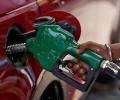
Petrol doped with 20 per cent ethanol was rolled out on Monday at select petrol pumps in 11 states and union territories as part of a programme to increase use of biofuels to cut emissions as well as dependence on foreign exchange-draining imports. At present, 10 per cent ethanol is blended in petrol (10 per cent ethanol, 90 per cent petrol) and the government is looking to double this quantity by 2025. Prime Minister Narendra Modi launched the higher 20 per cent ethanol blended petrol two months ahead of the planned rollout in April, at the India Energy Week (IEW) 2023 in Bengaluru.
Petrol prices may be cut by as much as Rs 1-1.50 per litre next week on falling international oil rates and appreciating rupee but a one-time hike in diesel and possibly LPG rates is still on the cards.
A source said on Tuesday that 'petroleum ministry is likely to propose deregulation of petrol prices and gradual phasing out of subsidies on diesel to ease burden on public sector oil marketing companies' -- indicating a possible hike of Rs 3 per litre in petrol rates.
The high-level Chaturvedi Committee has recommended raising petrol prices by Rs 2.50 a litre per month till March 2009 and diesel prices by Rs 0.75 per litre till 2010 to eliminate subsidies on the two fuels.
A top oil ministry official said it will be "suicidal" to even think of raising prices of diesel, LPG or kerosene just before Parliament is to meet.
State-run oil companies on Monday increased prices of diesel and petrol by Re 1 per litre each.
Petroleum Minister Ram Naik hinted on Wednesday that prices of petrol and diesel may be cut further at the fortnightly review on Thursday, in tune with the global softening of crude prices.\n\n\n\n
Petroleum Minister Mani Shankar Aiyar on Monday remained non-committal on rolling back the hike in petrol, diesel and cooking gas prices saying the demands for revisiting the decision could only be considered after the Prime Minister returns from The

No change in retail prices as oil marketing firms to absorb increase
The oil companies will meet on Friday for the review meeting on pricing in which petrol price could be increased by Re 1 and diesel prices by 50 paise by this weekend.

The three companies in separate presentations to the Kirit Parikh Committee on fuel pricing suggested immediate freeing of petrol and diesel prices from government control.

Gandhi said the one paisa cut in petrol rates was not a "suitable response" to the fuel challenge he threw to the prime minister a few days ago.
The government ruled out any major jump in petrol and diesel prices after the elections, but said a review to bring the domestic prices in line with the raw material cost will be done by the new government.
Under-recovery or the difference between retail price and its imported cost on diesel was 8 paisa per litre in the first half of September.
Petrol and diesel prices may be hiked by up to Re 1 per litre each on August 15, the next due date for fuel price revision, in step with the surge in global oil prices.
promises a mileage of 24.2 kmpl.
Petrol and diesel prices were on Wednesday hiked in seven states like West Bengal and Maharastra and that of domestic LPG in six states as state-owned oil firms recalibrated rates to reflect changes in local levies.
The fall in international oil prices has resulted in handsome margins for state-owned firms on petrol and diesel sales, but not all of it would be reflected in the cut in the retail selling price, as Finance Ministry wants to take away some of the gain by raising excise duty.

According to police, CPI-M legislator K Bhimrao and other party supporters were arrested from Guindy railway station in Chennai.
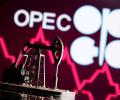
The surprise decision of OPEC and its allies, including Russia, to cut oil output may cause an immediate rise in prices, delaying revision in fuel prices in India, industry sources said. The grouping of Organisation of Petroleum Exporting Countries (OPEC) and its allies, called OPEC+, on Sunday decided to further cut oil output by around 1.16 million barrels. The move led to Brent rising by almost 6 per cent to $84.58 per barrel on Monday.

Decrying the hike in diesel prices as "unjustified" action, Tamil Nadu Chief Minister J Jayalalithaa on Tuesday demanded its roll back and withdrawal of powers granted to oil companies to regulate fuel prices.
The government on Tuesday said it has agreed in-principle to deregulate diesel prices, but is not considering similar proposal for the cooking gas.
An increase in petrol, diesel, domestic cooking gas (LPG) and kerosene prices looks "imminent" after the Finance Ministry said it has no money to provide for fuel subsidy.
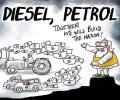
The government on Friday slapped an export tax on petrol, diesel and jet fuel (ATF) while also joining nations like the UK in imposing a windfall tax on crude oil produced locally. A Rs 6 per litre tax on export of petrol and ATF and Rs 13 per litre tax on export of diesel is effective from July 1, finance ministry notifications showed. Additionally, a Rs 23,250 per tonne tax was levied on crude oil produced domestically.
